One Pixel
So we have the multi-million dollar security breaches. And the worry about losing our personal information. But the cherry on top in this era of artificial intelligence has to do with one more thing. A pixel.
You can sometimes tell when photos are changed. Get that red eye out, crop that hair that is out of place. But with an image, a bad actor can make infinitesimal changes that the naked eye can not detect.
One pixel, in fact.

You don’t need to care if a pixel is off in your vacation photos.
But what happens if a pixel is hacked in an image that is used in an AI vision classification workload. And suddenly your pet dog is classified as a pet cat.
Now it may not be a big deal if your chihuahua is classified as a tabby.
But what if a medical image ends up being classified as a different type of cancer from what it is? What if the self-driving vehicle sees a clear road when there’s really a truck there? What if a dangerous weather pattern appears as nothing to worry about?
Yes, we need to worry about $ and PI. And now there’s life and death.
And the threat may not be from halfway around the world. It could come from your own backyard. Or even from inside.
That is why we need to be so vigilant on ensuring that data is encrypted – at rest and in flight, end-to-end. And focused on creating tools that do things like generating low-cost adversarial attacks against neural networks — for evaluating robustness against these very attacks.
Come innovate with us at our IBM Systems Co-Creation Lab. You and IBM experts work side-by-side to create first-of-a-kind strategies and solutions for your organization in AI, security, and other technologies. Contact us at design@us.ibm.com.
___________________________________________________________________________________________________________________________________________________________________________
The postings on this site solely reflect the personal views of the author and do not necessarily represent the views, positions, strategies or opinions of IBM or IBM management.
technorati tags: IBM, systems, performance,IT,capacity,planning,AI,computer,security,cybersecurity,encryption,pixel,neural,network
Cash or credit or . . .
Can you even remember the last time you used cash ? I think I used it to buy a cup of coffee 3 weeks ago in Philadelphia. And don’t even ask me when I used it before that.
Multiple forms of currency exist and it’s fit for purpose; basically, we use what is best for a particular situation.

Cash is now approximately 30-40% of how we transact business. And not surprisingly it’s declining. We don’t write many checks anymore. Credit and debit cards are of course a popular payment option. But the real future is in electronic and digital currencies.
We’ve heard about and read about and maybe even own cryptocurrencies. But don’t just think Bitcoin – most of us know that one because it was the first to use the underlying technology of blockchain. Organizations and industry groups are now beginning to create private cryptocurrencies for their customers. We are starting to see some central banks around the world use digital currencies. And company-branded specific cryptocurrencies such as one for photographers may achieve widespread adoption in addition to traditional cryptocurrencies.
But “with great power comes great responsibility.” Along with this growth may be more cybercrime and the need for stepped-up cybersecurity. Governance is important here and regulation is key. We are beginning to see some governments regulating. This can not happen fast enough.
So we can clearly see the future and the future is backed by blockchain — whether it’s currencies or healthcare data or mandarin oranges in the supply chain. Traceability saving time and money and lives — on premise, in the cloud, and even interfacing with artificial intelligence.
For many of us who rarely open our wallet the 30-40% statistic for cash initially seems rather high. Until we remember the gas pump that didn’t take credit cards, paying back your friend who doesn’t use venmo, and the purchase of the Thin Mints from the door-to-door Girl Scout. We’re getting there, but we’ve still got a ways to go.
_______________________________________________________________________
The postings on this site solely reflect the personal views of the author and do not necessarily represent the views, positions, strategies or opinions of IBM or IBM management.
technorati tags: IBM, systems, performance,IT,capacity,planning,blockchain,computer,currency,crypto,solutions,cash,benchmark,benchmarking
Blockland Rocks!
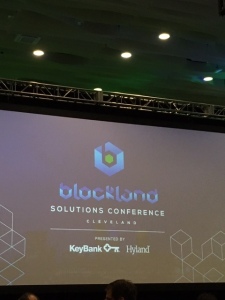
Cleveland is building a blockchain technology ecosystem. Yes, you heard that right — Cleveland. The Cleveland Blockland initiative exists to educate and promote real-world blockchain applications, while establishing and leading a blockchain ecosystem with support from private, public and philanthropic individuals and organizations.
I had the opportunity to work at the inaugural Blockland Solutions Conference this past week. IBM provided keynotes, speakers, labs and an awesome booth. 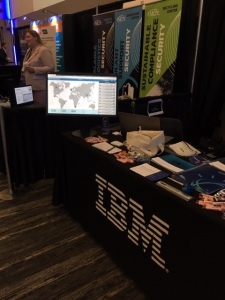
The focus was on key emerging technologies — blockchain of course, but also AI/ML, 5G and a huge industry focus. Recommendations on what you need to know:
1) emerging tech literacy first 2) then how things flow and how everything fits together (oh, sounds like an architect!) and 3) finally, deep technical expertise. Final words on emerging tech: Don’t opt out.
I learned about new use cases for blockchain: A ticket validation organization was highlighted – they chose IBM blockchain for its scale, integrity of assets to reduce risk, and the enterprise cloud. A potential blockchain app to authenticate printer ink to avoid counterfeiting was proposed. Other organizations discussed their work using IBM blockchain for shipping and their use of a center of excellence (which I always recommend)
Also discussed was how choosing applications for emerging tech comes down to ROI (which I always work on, way before the technology). 
I talked with numerous blockchain enthusiasts — from high school and college students just starting out to CEOs of blockchain startups to longtime technologists who were looking at or had started first projects.
We have a blockchain ecosystem in Silicon Valley. We have a blockchain ecosystem in Silicon Alley. Maybe it’s time for something in between.
************************************************
The postings on this site solely reflect the personal views of the author and do not necessarily represent the views, positions, strategies or opinions of IBM or IBM management.
technorati tags: IBM, systems, performance,IT,blockchain,computer,blockland,cleveland,solutions,conference
#NeedForSpeedHackathon, an awesome hack
This past weekend I had the wonderful opportunity to be part of the CMG NeedForSpeed Hackathon in our fair city of Cambridge, Massachusetts.


Computer Measurement Group (CMG) is a not-for-profit, worldwide organization of IT professionals committed to sharing information and best practices focused on ensuring the efficiency and scalability of IT service delivery to the enterprise through measurement, quantitative analysis and forecasting.
There were several amazing challenges in this hackathon and a big focus on healthcare and improving patient health. Pfizer, DataCore, and MathWorks were just some of the many awesome partners. I was a mentor, coach, and judge and also presented an innovation session on blockchain.
One team I advised used IBM Blockchain for medical records and one team used IBM Watson that I recommended for sentiment analysis for a meeting notes app. There were pitches for helping physicians, nurses, hospitals — and most of all, patients.
One of my favorite parts of the hackathon was “office hours.” I lounged on a fake leather couch in the corner of the venue while teams came to me to get ideas, discuss solutions and review their pitches. It’s so great to see what was created in so little time !
The youngest participants were 5 amazing freshmen from Northeastern. But there were also Machine Learning/Deep Learning experts of all ages to contend with. You can go to @CMGNEWS to see all the winners and their pitches !
Overheard in the hack room:
“Best hackathon ever” —> Of course, because CMG always runs a really good show.
“Best prizes ever” —> Love those drones !
“Best food I’ve ever had at a hackathon” —> Yes, Mary, they really really really liked the BBQ !
#NeedforSpeedHackathon That feel in the morning when you were coding most of the night. pic.twitter.com/hWa09MgQaS
— Collabots (@collabots) April 8, 2018
************************************************
The postings on this site solely reflect the personal views of the author and do not necessarily represent the views, positions, strategies or opinions of IBM or IBM management.
technorati tags: IBM, systems, performance,IT,capacity,planning,CMG,computer,measurement,group,hackathon,Computer Measurement Group,benchmark,benchmarking
Blockchain and Beyond: Wave or Storm? . . . And So Much More For High Growth Enterprises

Last week I had the honor of being part of an industry panel entitled “Blockchain and Beyond: Wave or Storm?” This panel was part of the CEO/C-Suite Summit: Engineered for Growth that was hosted by MAVA, a 30 year old association that focuses on investing in high growth enterprises.
Think of a powerhouse for startups.
Many times when I discuss the benefits and use cases for blockchain I am talking with the system architects, the programmers, the implementers. For this panel I was actually highlighting blockchain in front of many who could invest, and invest big, in this emerging technology.
Many of the tranformational topics I addressed focused on ones I have discussed in the past. How blockchain can reduce costs, eliminate intermediaries, reduce time, and increase trust. How there are many differences between an enterpise permissioned blockchain and a permissionless cryptocurrency. How large organizations are using blockchain technology — such as Maersk tracking shipping containers, Walmart tracing pork products, and Northern Trust managing private equity.
But for this panel there was also an investment perspective: Where is blockchain on the hype and adoption curves ? What did we think of the latest bitcoin value ? Is it the Wild West or time to invest ?

After my panel I attended an amazing CTO roundtable with a group of diverse technologists: a data analytics startup CTO, a Fintech advertising technologist, an academic research chief scientist, a VP of technology of an education startup, and a cybersecurity defense consultant (who could not tell us very much about what he does!). It was awesome to collaborate and realize that we all had similar challenges — everything from data accuracy to security encryption to hiring for our teams. Fun fact: 3 of the 6 CTOs in the room had an advanced degree in Physics and were now working in Machine Learning.
The final session in the event was “Perspectives on the Acquisition from Both Sides,” fascinating lessons learned from founders of companies who then went on to acquire other companies or be acquired. Once thing I learned is that it can sometimes take many many years for an acquisition. That you need to be able to walk away. That you need to realize that a great mark of success for a startup is to take part in either acquiring or being acquired. And that CEOs of startups wear jeans and cool socks !
The luncheon speaker was NY Times best-selling author Liza Mundy who wrote “Code Girls: The Untold Story of the American Women Code Breakers of World War II.” We heard a compelling historical perspective on the foundation upon which the technology community today has been built. Super inspiring.
Note that this Summit was not 3 days, not 2 days, or even 1 day. It was a few hours. I have been seeing this trend with the workshops and meetups that I do. Everyone is looking to get more in less time. This event really showed me how well this can work. In a similar vein, I also had a discussion with a CEO of a technology startup who told me that he is done with reading 5 page papers (I did not let on that I actually used to write 50 page papers !) He told me he gets the most value from an infographic or very short article where a couple of key insights are highlighted.
MAVA’s goal with these events is to deliver compelling insight, ideas and perspectives to fuel significant competitive advantage for companies being built. They definitely hit a home run with this one.
************************************************
The postings on this site solely reflect the personal views of the author and do not necessarily represent the views, positions, strategies or opinions of IBM or IBM management.
technorati tags: IBM, systems, performance,IT,MAVA,blockchain,startup,,CEO,benchmarking
The Old College Try
Today is a very big day for many high school seniors. At midnight tonight, early deadline college applications are due. And yesterday, the web portal used by more than a million students a year to submit these applications started having performance and availability issues and then shut down.
Needless to say, for many of these students Halloween was super scary in a real world sort of way. There’s already so much stress involved in applying to college and something like this impacts students, parents, high school professionals, colleges, and numerous others worldwide. And in my opinion, this didn’t have to happen.
I talk with many organizations about something called Best Execution Venue or Fit for Purpose. The concept is basically that you should choose the best technology for your workload based on local factors like non-functional requirements (such as performance and availability), architecture, skills, security and even politics. The best technology might be a mainframe. It might be an OpenPOWER system. It might be a public cloud. Or some architecture involving all of the above.
In this case, the college application site said that the portal ran into trouble because of “unusually large and intermittent spikes in system activity.” What a surprise. The use of this college application tool has been growing fast over the years and it is surely obvious that there would be a peak at this time. We have peaks in retail before the holidays. We have peaks in sporting events as they go live. And we have peaks in college applications right before the deadline.
It turns out that this site uses a public cloud (AWS). For the purpose of handling these peaks. Maybe this isn’t the best venue for performance and availability at this critical time.
One frustrated student tweeted “Does AMAZON Shut Down Hours Before Christmas? Does it Crash?” Ironically, he probably didn’t realize that he really was talking about Amazon.
************************************************
The postings on this site solely reflect the personal views of the author and do not necessarily represent the views, positions, strategies or opinions of IBM or IBM management.
technorati tags: IBM, systems, performance,IT,AWS,availability,college,,benchmark,benchmarking
Encrypting Everything Really Really Fast, 12 Billion Transactions per Day, at Less Cost !
Many of us don’t think of it every day but the IBM Mainframe actually supports:
- 87 percent of all credit card transactions and nearly $8 trillion payments a year.
- 29 billion ATM transactions each year, worth nearly $5 billion per day.
- Four billion passenger flights each year.
- More than 30 billion transactions per day – more than the number of Google searches every day.
- 68 percent of the world’s production workloads at only six percent of the total IT cost.
And now it’s here. The new IBM Z !!!
With the new z14, IBM takes TRUST to a new level by adding the ability to pervasively encrypt data on the platform. IBM Z pervasive encryption is a data-centric approach to information security — a transparent and consumable approach to enable extensive encryption of data in-flight and at-rest to substantially simplify and reduce the costs of protecting data and achieving compliance mandates.
With the z14 and pervasive encryption, organizations can:
· Encrypt all of the data associated with an application or database on IBM Z, whether at-rest or in-flight.
· Reduce the cost and complexity associated with implementing and maintaining encryption since no changes to the applications themselves are required.
· Protect data without impacting transactional throughput or SLAs.
· Transition from un-encrypted to encrypted databases without disrupting business operations (DB2 and IMS high availability databases).
· Drastically simplify compliance by quickly demonstrating to auditors that all data is protected.
This awesome new system can support > 12 billion encrypted transactions per day on a single system ! It can also encrypt data 18x faster at 5% of the cost of x86-based solutions [1].
IBM Z has been a leader in security with hardened capabilities architected into the hardware, OS and middleware for more than five decades.
Contact the IBM Systems Client Centers for more information or assistance.
************************************************
(1) Source: “Pervasive Encryption: A New Paradigm for Protection,” K. R. E. Lind, Chief Systems Engineer, Solitaire Interglobal Ltd., June 30, 2017.
The postings on this site solely reflect the personal views of the author and do not necessarily represent the views, positions, strategies or opinions of IBM or IBM management.
technorati tags: IBM, systems, performance,IT,IBMZ,z14,trustIBMz,encryption,Z,pervasive,ibmz,mainframe,security,client centers,benchmark,benchmarking
A Journey to Blockchain
So you’ve heard about blockchain, know you want to get started with it, would really like to reduce costs, risk and process time. What are some of the keys to a successful adoption of blockchain?
In many cases work with blockchain starts as an experiment. A first test should be a relatively easy one – for example, a digital thank you for employees. That success can lead to pursuing a few Use Cases such as Payments, Fraud, Tracking, etc. It is critical to partner with a close distributor, business partner, supplier, friend, who will work with you. IBM did exactly this with our IBM Global Financing adoption of blockchain to reduce disputes — Lenovo was an initial partner.
Proof of Concepts and Use Cases are key to the blockchain journey. The best Use Cases are ones that are not too easy but not too hard. A purely internal use case is almost useless. You want a first Use Case that contains only a few nodes but that will create a large enough ROI to demonstrate a successful business case.
A cultural shift is a large part of the process, using the 80-20 rule: 80% shift of business processes and 20% technologies. I always say that the technology is the easier part; governance is harder.
That’s why it is beneficial to create a “Center of Excellence” to focus on blockchain:
1) To get your hands dirty
2) To explore Use Cases
3) To create a dedicated team and management
Challenges in the journey may include:
* Platform selection
* Lack of enterprise standards
* Lack of licensing models standards
* Management of organizations
* Quantitative validations of business cases
* Lack of skills
IBM Client Centers can assist with all of these challenges to make it a smooth journey. From taking advantage of the open source aspects of the Hyperledger Fabric and IBM Blockchain implementation to helping you choose the right Use Cases to architecting your applications.
So get going now on the journey to blockchain !
************************************************
The postings on this site solely reflect the personal views of the author and do not necessarily represent the views, positions, strategies or opinions of IBM or IBM management.
technorati tags: IBM, systems, performance, workload, blockchain,optimization,Hyperledger,Linux,Academy,Technology,LinuxOne,HSBN,platform,data center,finance,fabric
When You Wish Upon a Star – A New Performance Website !
When I was in college, one of my favorite places to go (to get away from my theoretical math classes) was the city art museum. I would leave my dorm really early in the morning — it must have actually been about 11AM — walk over the bridge, through many deserted city blocks and then over to the museum, grabbing a hot pretzel along the way. The journey seemed to take forever, much of it through an urban wasteland.
One of my dreams during this time involved a shortcut of sorts. In this dream, I would leave campus, cross the bridge and immediately take a short stroll along the river over to the museum. And it certainly was a dream – as the area where this supposed trail would be consisted of old train tracks, trash, brush, debris, waste, refuse, rubbish, litter, scrap, flotsam and jetsam, rubble and detritus.
Many years later, I returned to my alma mater. And found myself crossing the bridge once again to go to my favorite museum. But this time as I approached the end of the bridge I suddenly saw a stairway the went down to the river. And I took it. And lo and behold, there it was — the path of my dreams, a bike and hike paved trail that followed along the river, directly to my beloved art museum.
These amazing things don’t happen very often but when they do you can’t really believe it. And that’s what I’ve been thinking about a new awesome website from IBM.
For many years, as some of you know, I worked on industry standard benchmarks, writing articles about IBM and other results and highlighting comparisons. First it was in a newsletter, then an internal company website, then this blog — but I always dreamed that there would be a one-stop shop for everyone to go to see all the new and exciting benchmark results. And now we have it.
You can now find detailed IBM Power Systems performance data proof points. This brand new website contains test results for several different IT area workloads:
• Big Data and Analytics: Showing faster time-to-value of big data. Discover how hadoop innovation can deliver faster, more affordable business insights
• Technical Computing: See how IBM Power Systems solutions deliver faster time to insight and offer accelerated performance for demanding HPC workloads
• Cloud: Find how to run swiftly and smoothly on a high performing global infrastructure. Deploy global cloud infrastructures rapidly on virtual servers
• Virtualization: See how new virtualization technology makes deploying applications easier
• Online Transactional Processing and Enterprise Resource Planning: IBM and SAP industry-leading performance across multiple workloads.
Sometimes dreams do come true.
************************************************
The postings on this site solely reflect the personal views of the author and do not necessarily represent the views, positions, strategies or opinions of IBM or IBM management.
technorati tags: IBM, systems, performance,IT,industry,standard,results,hadoop,computer,HPC,
Blockchain on my Mind
It’s really hard to believe but I actually used to go hiking in jeans. That’s right, blue jeans. 100% cotton blue jeans.
Long before “cotton kills” became the mantra of the North Face set, everyone hiked in jeans. For years — mostly in the beautiful sunny summer, south of the Mason-Dixon line — it was actually just fine.
Until one day I got caught in a giant frigid rainstorm on Cannon Mountain in the White Mountains in New Hampshire. I quickly became soaked with icy water, my jeans drenched and hanging heavy. I’ll never forget getting off that mountain, jeans glued to my chilled skin. And then stripping down in the mountain parking lot, spreading everything on top of the car to dry out in the warm sun that had suddenly appeared.
A few years later I discovered these new zip-off hiking pants that could get wet and then dry almost instantly. This technology became a game changer for me. Suddenly, I achieved a decrease in unpleasant hiking time, a reduced risk from illness, and lower costs by avoiding a bad day on the mountain.

Blockchain, the distributed ledger that is everywhere in the news, is similar. Like with the zip-offs, some of us may be early adopters, some of us may have not even heard of it yet. But it’s a groundbreaking technology that is changing business at a breakneck speed.
Blockchain is a technology for applications that establishes trust, accountability and transparency while streamlining business processes. Approvals for items like letters of credit, invoices, mortgage verifications, clearings, and money transfers can now be done right away — and not take days to weeks to even months.
And don’t think that blockchain is just for the financial industry. The ledgers and smart contracts have great value cross-industry including supply chain, healthcare, government, retail. I’ve seen it work for shipping companies. I’ve seen an excellent use case for insurance companies. I’ve seen it replace lawyers.
IBM is part of the Hyperledger Project, a collaborative effort created to advance blockchain technology by identifying and addressing important features for a cross-industry open standard for distributed ledgers that can transform the way business transactions are conducted globally.
IBM can help with understanding which of your applications will benefit from blockchain and how to get started. Some sure indicators that a workload could benefit from blockchain include managing contractual relationships between more than two parties, complex business logic, and looking to reduce cost.
Using high end systems such as IBM z and Power systems for blockchain implementations is key. Blockchain can be deployed on these systems or connect to these systems to take advantage of the fast processors, memory, cache, hardware accelerators and cryptography, security and integration. The GoLang APIs, the RocksDB database, and the security and consensus algorithms, all on which blockchain relies, can really benefit from these features.
(In fact, lately I’ve been finding it hard to stop thinking about blockchain. True story: Late last night I was innocently reading a book on the couch about Rosemary Kennedy while someone in my family was fixing our kitchen door. And suddenly he started talking about the block plane he was using . . .)
Blockchain addresses 3 of the most important things in the world: Time, Cost, and Risk. So pick a project and get started. Like zip-offs, the world will never be the same.
************************************************
The postings on this site solely reflect the personal views of the author and do not necessarily represent the views, positions, strategies or opinions of IBM or IBM management.
technorati tags: IBM, systems, performance,IT,blockchain,hyperledger,ledger,bitcoin,computer,shared,GoLang,

 benchmarkingblog